What Does a Value Management Office Actually Do?
Most articles answering this question give you a list: governance, reporting, prioritisation, benefits tracking. Each item sounds reasonable. None of them tells you what the function actually does on a Tuesday morning.
That is the wrong way in. A Value Management Office is not defined by its task list. It is defined by the decisions it changes and the conversations it forces.
So instead of another bullet-point job description, here is what a VMO actually looks like in practice.
Three decisions a VMO is built to own
Every organisation running more than a handful of concurrent projects is continuously making three decisions, whether it recognises them or not. And almost none are making all three well, because in most organisations these decisions are handled by different people, with different information, governed by different processes, with no connection between them.
The three are:
- What enters the portfolio - which work gets approved, and at what point does new demand arrive at the system?
- How constrained capacity is sequenced - once work is inside the portfolio, in what order does it actually get done, and which projects get the attention of the resources whose hours are most limited?
- When to intervene - as conditions change, who decides how the portfolio responds, how quickly, and based on what?
A traditional PMO is usually involved in the third decision and only the third. The first two are made elsewhere - in investment committees, in resource conversations, in steering groups - and the connections between them are weak or non-existent. That disconnection is not a governance failure. It is a structural one. And it is where the majority of value is quietly lost in complex portfolios.
A VMO owns all three as a connected decision system. Approvals are informed by what the portfolio can actually deliver. Sequencing is informed by what was promised in the business cases. Interventions are informed by economic consequence, not by whoever is loudest in the room. The three decisions stop being separate handoffs and start being a single closed loop.
That loop is the function. Everything else is supporting infrastructure.
What that looks like on a Tuesday morning
On Tuesday morning, that might mean five very practical activities.
It looks at the portfolio and asks where value is being delayed, not just where projects are slipping. A six-week slip on a strategic initiative is not the same as a six-week slip on a low-value one. The VMO makes that distinction visible.
It identifies which constraint is actually limiting throughput. In most multi-project organisations, the bottleneck is not method or governance. It is a specific group of people, a specific skill set, or a specific piece of infrastructure that every important project depends on. A VMO names that constraint and protects it.
It sequences work so that value is unlocked sooner, not just delivered eventually. Two projects of equal size do not produce equal economic value. The VMO is responsible for understanding the difference and influencing the order accordingly.
It translates portfolio behaviour into executive language. When a CFO asks "why is this slipping?", a VMO does not answer in resource utilisation percentages. It answers in delayed revenue, deferred savings, and missed market windows.
It feeds delivery data back into selection decisions. The next round of investment choices is informed by what the last round actually cost and produced - not by what was forecast a year ago.
The role a VMO plays in the organisation
A VMO is an organisational unit, not a methodology. It does not replace Agile, PRINCE2, SAFe, or any other delivery approach. It works across delivery methodologies and asks whether the portfolio is producing the best economic return from the capacity available.
That position is what makes it useful. The VMO is the place where strategy meets capacity. Where business case meets delivery reality. Where the question "is this still worth doing?" can be asked without it being a political event.
In practical terms, that means the VMO is the function senior leaders go to when they need a defensible answer to questions like:
- If we accept this new initiative, what will it delay, and what does that delay cost us?
- Which of our active projects, if we stopped them today, would we miss the least?
- Where is our portfolio actually constrained, and what would relaxing that constraint be worth?
- Are the benefits we promised in the original business cases still on track to be realised?
These are not questions a steering group can answer with a status report. They require the function to hold value, capacity and execution in the same view - which is exactly what a VMO is set up to do.
What changes when a VMO is in place
The clearest test of whether a function is doing VMO work is to look at what changes in the business.
Decisions about which projects to start get sharper. The portfolio gets smaller, not larger, because the function is now able to defend the decision to say no. The remaining work has clearer economic justification, which makes it easier to defend when budgets tighten.
Conversations at executive level change shape. Reports stop being lists of project statuses and start being summaries of portfolio economics - what is being delivered, what is being delayed, what that means in financial terms, and what the recommended interventions are.
The bottleneck stops being a mystery. Once the constraint is named, the organisation can either protect it, expand it, or work around it. Either way, the political conversation about resourcing turns into an economic conversation about return.
And, crucially, the delivery function gets easier to defend at the board. A VMO produces the language executives need to see project investment as economic activity rather than overhead.
What the highest-maturity version looks like
The more mature VMOs operating today are doing much of the work described above. They have started to shift from delivery governance to economic decision-making, and the business is already getting better answers as a result.
But there is a higher level - a version of the VMO that very few organisations have reached, because the intellectual framework for it has only recently become operational.
At that level, the central question changes. It is no longer "what should we work on next to maintain flow?" It becomes "what should we work on next to maximise the economic value produced by each hour of our constrained resources?"
That is a fundamentally different question. It treats delivery timing as a financial event, not a scheduling one. A project delivered three months early is not a scheduling success - it is value arriving sooner, and that has a calculable financial worth. A project delayed by three months is not a missed deadline - it is value being destroyed, and that has a calculable cost.
A VMO operating at this level lets the system guide sequencing rather than relying on human judgement to manage complexity it cannot fully see. Leaders are freed from the decisions the system can make better, and can focus their judgement on the decisions that genuinely require it. Investment, acceleration, and cancellation decisions are made with full visibility of what each option is economically worth.
This is not a distant aspiration. It is the next stage of maturity - and there is a practical path to reach it. It is the fullest expression of what a VMO can do.
The question this actually answers
"What does a Value Management Office do?" is the surface question. The real question underneath it is usually "what would change in our business if we had one?"
The answer is that fewer wrong projects get started, the right ones get sequenced for maximum value, and the conversation with executives stops being about delivery and starts being about return.
That is not a new department doing new work. It is the function you already have, doing better work, with the economic frame it was always missing.
Take the next step
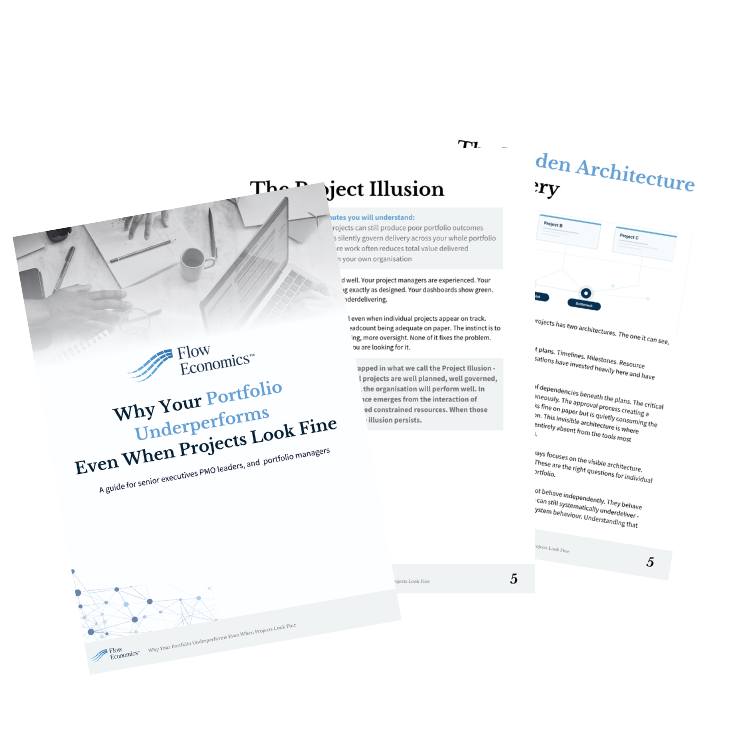
If you recognised your function in the description above, the PMO to VMO guide is the deeper playbook. It explains how to connect the three decisions every portfolio depends on - what enters the portfolio, how constrained capacity is sequenced, and when to intervene - and how to make the shift from delivery governance to value management without restructuring.