Value Management Office vs PMO: The PMO Is Evolving, Not Being Replaced
Search for "VMO vs PMO" and you will find a confident answer almost everywhere: the Value Management Office is a new department that sits above the PMO, doing the strategic value work while the PMO continues to manage delivery.
That framing is wrong - and it creates exactly the turf war PMO leaders should be avoiding.
A Value Management Office is not a new function bolted on top of the PMO. It is what the PMO becomes when it stops measuring only whether projects are being delivered and starts deciding which work creates the most value, in what order, given the constraints the organisation actually has.
In other words, the VMO is not the replacement for the PMO. It is the PMO evolving.
So, what is a Value Management Office?
A Value Management Office is what a PMO becomes when its role extends beyond delivery governance into economic decision-making across the portfolio.
It does not simply ask whether projects are on time. It asks what value is being delayed, what constraint is causing the delay, and which intervention would create the highest return.
That is the real shift. Not from project management to strategy. From delivery governance to economic decision-making.
What a PMO was built to do
A Project Management Office exists to make project delivery repeatable. Standardised plans. Clean governance. Consistent reporting. Defined methods. A mature PMO raises the floor on delivery quality, gives leadership visibility, and makes individual projects more likely to succeed against their own plan.
That work is genuinely valuable. Without a PMO, most multi-project organisations descend into chaos within a year.
But notice the questions a traditional PMO is not designed to answer:
- Are we running the right portfolio in the first place?
- What is the economic cost of delay across the portfolio, not just on a single project?
- Where is the constraint that genuinely limits how much value we can deliver?
- Which projects, if accelerated, would unlock disproportionate financial return?
A traditional PMO operates inside the assumption that the portfolio is correct and the only question is execution. That assumption is often wrong - and the PMO is usually the first function to feel it.
The Project Illusion
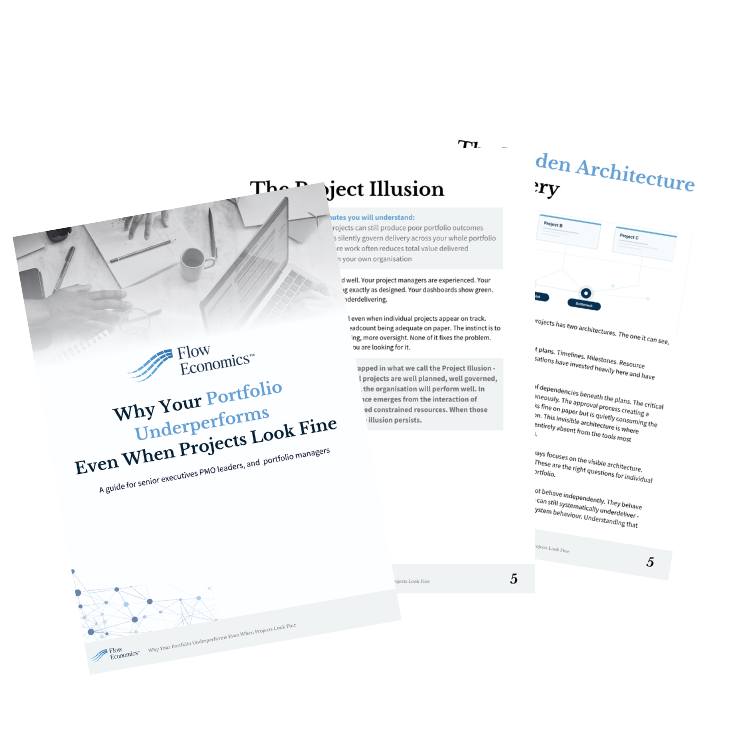
The reason a PMO can do its job well while the business still underperforms has a name. We call it the Project Illusion:
Many organisations are trapped in what we might call the Project Illusion: the belief that if individual projects are well planned, well governed, and delivered successfully, the organisation will perform well. In reality, portfolio performance emerges from the interaction of projects competing for shared constrained resources. When those constraints are invisible, the illusion persists.
Read that twice. It is why green projects can produce a red portfolio. It is why resource conflicts dominate every steering group. It is why your dashboards keep improving while your sponsors keep getting more frustrated.
A PMO that addresses the Project Illusion is no longer just a PMO. It has started doing the work of a Value Management Office.
The shift, not the split
A Value Management Office is an organisational unit, not a methodology. The cleanest way to understand it is by what changes when a PMO evolves into one.
A PMO asks: are we running this project well?
A VMO asks: are we running the right projects, in the right order, given what our organisation can actually do?
The traditional PMO scope - methods, governance, reporting, assurance - does not go away. It gets absorbed into a function with a wider remit and a sharper purpose. The team that was making sure projects deliver to plan is now also making sure the plan itself is delivering value.
That is the shift. Not a new department. A new mandate for the function you already have.
What the evolved function actually does
A function operating as a VMO is responsible for more than the traditional PMO scope. It adds:
- Identifying the constraint that genuinely limits portfolio throughput
- Quantifying the financial impact of delay, congestion and competing priorities
- Sequencing work so that value, not utilisation, drives the schedule
- Translating portfolio behaviour into language executives can act on
- Linking strategic intent to delivery capacity in a way that is measurable
These are not extra admin tasks for the PMO. They are a better way of doing the work the PMO was already trying to do - connecting delivery reality to executive decision-making in economic terms.
Three signs your PMO is already evolving
Most PMOs do not formally decide to become a VMO. They drift into it because the questions they are being asked outgrow the scope they were given. If any of these patterns are familiar, the evolution is already in motion:
- You spend more time explaining trade-offs to leadership than running project reviews. The conversation has moved from "is this project on track?" to "should we even be doing it given everything else in flight?"
- Your dashboards show green projects in a red portfolio. Individual projects meet their measures, but the business is not getting the outcomes it expected.
- Resource conflicts dominate every steering group. People are the bottleneck, not the plan, and reallocating them is a political conversation rather than an economic one.
None of those problems get solved by tightening governance or adding another reporting layer. They get solved by completing the evolution your function has already started.
Why the "VMO on top of the PMO" framing fails
Some advisors will tell you to set up a Value Management Office as a separate department above your existing PMO. It is worth understanding why that often fails in practice.
It creates two functions competing for the same conversations. It splits accountability for portfolio performance between a team that owns delivery and a team that owns value, which guarantees that neither owns the outcome. It asks the executive sponsor to fund a new headcount line, when the more honest ask is for the existing function to be given a wider mandate.
And, most damagingly, it leaves the PMO permanently positioned as a backward-looking governance shop. That framing is the reason PMO leaders get marginalised in strategy conversations - and it is the framing the evolution thesis is designed to break.
Where the evolution leads
A Value Management Office is what a PMO becomes when it earns the right to influence which projects get done, not just how. It keeps everything the PMO already does. It adds the economic layer that the PMO was always missing.
That evolution does not happen by changing the sign on the door. It happens by changing what the function measures, what it reports on, and what it is permitted to decide.
If your PMO is already wrestling with portfolio-level value questions, you do not need a new department. You need to recognise the function you are already becoming, and finish the journey deliberately.
Take the next step
If this sounds like the conversation your PMO is already being pulled into, the PMO to VMO guide will help you frame the shift clearly. It explains what changes, what stays the same, and how to make the case for a wider mandate without creating another layer of governance.